As ideas of our film opening progress, when it comes to narrative style, what we need to bare in mind is how our target audience will follow the story arc within the sequence. Because we as film makers already have prior knowledge on the narrative we want to tell, we need to make a point of making each aspect of our film clear to our audience. We plan to address this by having a non-diegetic voiceover to provide context and quickly establish an emotion connection between the audience and the main protagonist, as they empathise for the emotional trauma he is going through. We will also do our best to present the settings in a similarly melancholy way to the reflect the characters thoughts and feelings, while also helping to establish a mood and tone. For example, one of the shots we have in our sequence is a side on shot of our main protagonist waling from one side of the screen to the other. This has connotations of quite a clinical and two dimensional nature, which informs the audience of that particular characters persona and general outlook on life.
To conclude, throughout each stage of our development, why and how our target audience of male teenagers and young adults will react to the opening content plays a critical part in identifying both them and our film's genre. Knowing this, we can now consider all of these elements as we proceed with editing more cuts of the sequence to create a sense of professionalism within our film.
- Ryan Chapman -

Friday, 28 February 2014

Thursday, 27 February 2014
How we will attract our target audience
Through research into films similar to our own, it's apparent that films attract audiences by establishing a certain tone that's often enigmatic to entice and intrigue audience members, while they also use iconography to make their film distinctive and generate a fan base. An example of this can be found in the film 'Revolver,' with the element of mystery playing a key part in the films narrative as well as Guy Richie's iconic directorial style presenting the film in a very distinctive and thus memorable light. This film also elaborates on the aspect of gambling, with a majority of the settings being centered around casinos, identifying it's target audience as a more adult age group, because they are the only ones who can fully comprehend the feelings associated with taking such high stake risks. In regards to the characters, the main protagonist is seen to have a non-diegetic monologue throughout the narrative so that the audience can get a better understanding of what motivates him and why. This helps to attract an audience of high intellect who can interoperate this character in-depth and therefore take more away from the film. All of these signifiers are evidential of my point that Guy Richie attracted an adult male audience by highlighting elements that are stereotypically associated with both their age group and gender.
This information will aid us in knowing what particular techniques we should use to attract our target audience and identify them as our main focus. After looking at this film, some exemplar techniques for us to appeal to our target audience of male teenagers and young adults would be to incorporate a character of similar age to make that person more relatable, as well as conveying them with quite mature mannerisms. These techniques will make it easier to identify our target audience and therefore make them more willing to invest in our film's narrative.
- Ryan Chapman -
This information will aid us in knowing what particular techniques we should use to attract our target audience and identify them as our main focus. After looking at this film, some exemplar techniques for us to appeal to our target audience of male teenagers and young adults would be to incorporate a character of similar age to make that person more relatable, as well as conveying them with quite mature mannerisms. These techniques will make it easier to identify our target audience and therefore make them more willing to invest in our film's narrative.
- Ryan Chapman -
Wednesday, 26 February 2014
What certificate our film is
Our film certificate is 15.
This is due to the complex and emotional themes that will be portrayed throughout the piece which may cause slight distress in the younger audiences. This may also cause the younger generations to become unease as some of the themes will be quite in-depth and mature which will be portrayed in this film.
Through the BBFC ratings this confirms the idea of a 15 rating for our film. In a 15 film there will be several themes present.
strong violence
frequent strong language (e.g. 'f***').
portrayals of sexual activity
strong verbal references to sex
sexual nudity
brief scenes of sexual violence or verbal references to sexual violence
discriminatory language or behaviour
drug taking
These are all portrayed in our film. Mainly the frequent language and strong violence.
- Peter Godwin -
This is due to the complex and emotional themes that will be portrayed throughout the piece which may cause slight distress in the younger audiences. This may also cause the younger generations to become unease as some of the themes will be quite in-depth and mature which will be portrayed in this film.
Through the BBFC ratings this confirms the idea of a 15 rating for our film. In a 15 film there will be several themes present.
These are all portrayed in our film. Mainly the frequent language and strong violence.
- Peter Godwin -
Tuesday, 25 February 2014
Group discoveries on title timlines
Looking at more examples of the Drama genre, it has become apparent that a lot of them integrate the lengthy titles into slow paced sequences, that often consists of a lot of establishing shots to convey a certain tone that is echoed throughout the film while also introducing the setting in a very stylised way. Most Dramas have a lot of titles because, as seen in our previous blog on why we chose the genre, they are a favourite when it comes to winning awards, which means people involved in the film making process want visual credit within the film to maintain or even improve their reputation of high quality products throughout the film industry.
An example of this can be seen in the opening sequence to the film 'Fargo.' What's significant and unique about this opening is that, in regards to the establishing shots, it defies convention with the entire opening being one continuous take. The fact that there isn't any distinguishable scenery within this shot backs up my point that in a majority of dramas the film makers want the focus to be on the titles so that people are more aware of who specifically worked on the film and can put it into context for future projects. This also results in a slower and more progressive pacing, which is apparent in most Dramas, as well as builds tension more gradually which, particularly with 'Fargo,' is essential in regards to enticing the audience.
Below is a timeline depicting all of the titles and identifying their chronological order:

~Ryan Chapman~
An example of this can be seen in the opening sequence to the film 'Fargo.' What's significant and unique about this opening is that, in regards to the establishing shots, it defies convention with the entire opening being one continuous take. The fact that there isn't any distinguishable scenery within this shot backs up my point that in a majority of dramas the film makers want the focus to be on the titles so that people are more aware of who specifically worked on the film and can put it into context for future projects. This also results in a slower and more progressive pacing, which is apparent in most Dramas, as well as builds tension more gradually which, particularly with 'Fargo,' is essential in regards to enticing the audience.
Below is a timeline depicting all of the titles and identifying their chronological order:
~Ryan Chapman~
Monday, 24 February 2014
Current popular dramas
 On I.M.D.B., the most popular drama is currently 'Transcendence.' It's popularity is partly due to the production company being Warner Brothers, whom are well known throughout the media as being one of the most successful and longest running film companies in the world. The other reason for this films popularity among the film community is the numerous amount of A list actors that are in it, such as Johnny Depp, Morgan Freeman and Rebecca Hall. This means that loyal fans of each actor will see this film, as well as those who are already keen on the drama genre, thus resulting in a mainstream target audience. As of the end of April, in the 2 weeks the film has been in cinemas, it has made almost $32 million, however, considering the film cost $100 million to make, this shows that this film isn't likely to thrive. Similarly, with an all American cast and setting, there isn't much content within the film that appeals to a British audience.
This film is evidence that timing is a big part of what makes a film financially successful, with other big Hollywood films such as 'Captain America: The: Winter Soldier' and 'Noah' overshadowing this films release, and therefore directly resulting in a lack of high box office figures.
When comparing this film to our own, there are similarities in the techniques we have used to make our film successful and a memorable example of the drama genre. For example, we have also used multiple celebrities to present our film as a more legitimate, mainstream and enjoyable product as well as make a point of conveying our production company as somewhat of a rival to Warner brothers when it comes to popularity and financial gain.
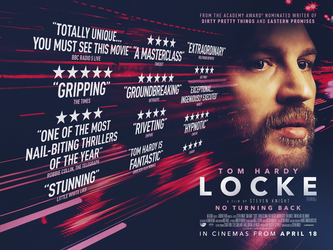 An example of the drama genre that is a current favourite among both critics and fans a like is 'Locke.' In contrast to 'Transcendence,' this film targets a more niche audience, with Tom Hardy being the only well-known cast member, this only being the directors second time in the role and the film company (IM Global) only dealing with smaller budget films, than those belonging to Warner Brothers. Despite this, the film does have a significantly higher rating on I.MD.B., currently receiving a 7.7/10 rating from the public and a 79/100 metacritic score. 'Locke' also uses the narrative to incorporate signifiers that appeal more to a British audience, such as the setting being London and the main protagonist being of the same region. This combination means we can find the narrative more relatable and therefore be more willing to invest our time into.
- Ryan Chapman -
Sunday, 23 February 2014
How our target audience was decided

Husky Productions understands the different audience theories and have chosen to incorporate the Uses and Gratification model, as it is widely accepted as a contemporary, and therefore very relevant, theory in the world of media, specifically the need for entertainment and knowledge aspects. The entertainment will be derived from the over all enjoyment of our product, while the knowledge will come from the moral message we've placed in our narrative which is to never change who you are for the sake of wealth. This will help to get the audience thinking and see this film as a source of personal identity.
- Ryan Chapman -
Saturday, 22 February 2014
The list of scenes within our whole film
- Park - Scofield mourns the death of his friend
- Bridge - Scofield contemplates his life choices -- concludes opening sequence.
- Flashback to 2 years ago in a high street in Hackney, London - Scofield is hanging out with his friend Mark
- Apartment in Hackney - A man in a suit exchanges a few words and shakes hands with an ex convict and walks out
- High street - The man in the suit walks past Scofield and Mark, with Scofield asking what the man does for a living and becomes inspired to be a businessman
- Scofield's apartment - He wakes up the next day still thinking about the previous night, he calls up Mark and pitches him the idea that they should run a business together
- Mark's apartment - Scofield enters the apartment and sees drugs on Mark's table, telling him they need to make changes in their lives
- Montage - The two of them makes plans as to what kind of a business they could run together and they decide on a restaurant, selling a majority of their possessions to afford the rent
- High street - They open up their new business and the man in the suit walks past again and notices the new establishing, walking in and greeting Scofield and Mark. The man tells them they should join him at his firm, and they pass, with him leaving his card in the counter in case they change their minds
- Restaurant, night time - Scofield is clearing up and stumbles upon the card the man left, looking around and then putting it in his pocket
- Scofield's apartment - He sits in an arm chair with the card still in his hand thinking about the man's offer
- Restaurant - Scofield tells Mark that he's going to work at the firm, with Mark telling him he's making a mistake and that he can't trust the man in the suit
- Firm - Scofield gets introduced to his colleges and gets set up in his new office. He starts to work and notices some anomalies within the firms accounts. He talks to his boss, whom ignores it and at the same time tells Scofield he needs to go and reposes a business that turns out to be the restaurant that now belongs to Mark.
- Restaurant - Scofield tells Mark he's getting kicked out, with Mark begging him not to do this but gets ignored.
- Firm - Scofield's boss congratulates him while Scofield looks out his window in despair
- Scofield's apartment - 3 months later, Scofield comes home from work and turns on the TV to the news and finds out that Mark had been killed during a drug raid in Hackney and he now feels responsible
- Bridge - Scofield contemplates what to do with his life and walks away
- Restaurant - Scofield burns down the old restaurant and recruits a young man to be his apprentice in running the new store that he has opened, with the sign under the door stating 'In Memory of Mark Hitching.'
Friday, 21 February 2014
Mood board
This is a mood board that displays the key elements that help to define our genre, as well as create an atmosphere that can be seen throughout our film's narrative. These themes include regret, mourning, hope, choices and the differences between right and wrong. An example of how this links to our film opening can be seen with the man in the middle of the picture and how he reflects our main protagonist and the enigmatic state he is in. This sense of mystery will help to entice our audience by generating questions such as what lead him to be in this state and does this problem he faces ever become resolved?
~Ryan Chapman ~
 |
~Ryan Chapman ~
Thursday, 20 February 2014
Questionnaire results and evaluation
To get a better idea of the kind of audiences that are associated with a particular genre, we created a questionnaire and gave it to a wide variety of people to fill out, making the results non-biased and therefore more dependable. Doing this questionnaire gave us a better idea of what specific target audience we should appeal to, depending on our genre, and how the general public associate these stereotypes.
Here is a copy of the questionnaire:
What is your name?
…………………………………………………………………………
………………………………………………………………………..
Here is a copy of the questionnaire:
Audiences – genre questionnaire
What is your name?
…………………………………………..
How old are you?
………………….
………………………………………………………………
What age group would you usually expect to see a horror film?
………………………………………………………………….
What is it do you think that appeals that target audience to the horror genre?
…………………………………………………………………………
…………………………………………………………………………
What age group would you usually expect to see a romantic film?
…………………………………………………………………….
What is it do you think that appeals that target audience to the romantic genre?
………………………………………………………………………..
……………………………………………………………………….
What age group would you usually expect to see an action film?
…………………………………………………………………
What is it do you think that appeals that target audience to the action genre?
………………………………………………………..
……………………………………………………….
……………………………………………………….
What age group would you expect to see a comedic film?
………………………………………………………….
What is it do you think that appeals that target audience to the comedy genre?
……………………………………………………………….……………………………………………………………….………………………………………………………………
Here is a graph displaying the results of the 20 questionnaires I handed out, to show what the most popular genre is:

This graph is evidence that suggests the favourite genre among teenagers is comedy. Knowing this, we now know that our drama genre is to be targeted at a more adult audience, as apposed to younger. After collecting the results it was conclusive that a majority of the people found the comedy genre to be the most enjoyable and used the stereotypes that they already knew and applied them to their answers. For example, one person answered the question of what they thought it was that appealed the romance genre to it's target audience, stating 'Tend to light-hearted feel good films.' This shows how much of a general consensus stereotypes have become, which is why they're used so often in films, as well as to appeal to a particular audience.


Wednesday, 19 February 2014
Research into genre: Crime/drama
As technology has become more accessible and convenient for the public, thanks for digitalisation, children now have easier access to films that have high age ratings. That means that audience members now have higher demands, when it comes to the extremity of the content, with an example being the controversy surrounding ‘Casino Royale’s age rating being a 12A in cinemas, despite a graphic torture scene, leaning it more towards the conventions of a 15 rating. It is this extremity that has caused older dramas, such as ‘The Godfather,’ to now have a lower age rating than they did when they were originally released. This differs from ‘Casino Royale’ because, although they’re both subgenres of drama, ‘The Godfather’ elaborates more on the gangster and crime elements, whereas ‘Casino Royale’ focuses more on the action orientated aspect. The drawback of this new need for extremity is that a higher rating means a smaller target audience, directly resulting in a smaller profit margin for the film companies involved. To avoid this, well-established directors, such as Christopher Nolan and Ben Affleck, use more subtle techniques to convey these darker themes, compared to pre-2000 films that were more visually extreme, with exaggerated uses of blood and violence.
 By contrast, ‘The Dark Knight’ is a good example of a modern drama, being commended for its darkly-themed writing and in-depth character development, still conveying an adult tone, but also appealing to children, with the use of an iconic superhero. This picture of the film’s antagonist displays stereotypical traits of a drama by taking something kids find humorous (clowns) and turning it into something more psychologically intimidating, because of this contrast. It follows the structure of a drama with the use of binary opposites (hero vs. villain), characters that evolve and have a change in dynamics with others, to represent a sense of progression. An example of this change can be seen in the character Harvey Dent, starting off as a loyal and determined lawyer and gradually becoming more sinister and vengeful.
This is a picture our group constructed to visually summarise the drama genre, through symbolism, and some of the consistent conventions that can be seen in them. The distressed man shows the confusion and lack of clarity, the scales relate to the binary opposites and moral judgement, the path refers to the choices the characters make, the sun rise symbolise hope and the central man in the suit visually demonstrates mourning.
Here is a trailer of the film 'The Town,' which carries similar guidelines to the film we have constructed, from a narrative perspective, and is a good example of a modern drama:
In conclusion, the drama genre has lengthy history and diversity, with numerous subgenres that each elaborates on different elements of drama to make a more memorable and unique narrative.
~ Ryan Chapman ~
Opening Sequence of Anatomy of a Murder

~ Peter Godwin ~
By contrast, ‘The Dark Knight’ is a good example of a modern drama, being commended for its darkly-themed writing and in-depth character development, still conveying an adult tone, but also appealing to children, with the use of an iconic superhero. This picture of the film’s antagonist displays stereotypical traits of a drama by taking something kids find humorous (clowns) and turning it into something more psychologically intimidating, because of this contrast. It follows the structure of a drama with the use of binary opposites (hero vs. villain), characters that evolve and have a change in dynamics with others, to represent a sense of progression. An example of this change can be seen in the character Harvey Dent, starting off as a loyal and determined lawyer and gradually becoming more sinister and vengeful.
|
| ~ Made By: Christina Fraser, Ryan Chapman and Peter Godwin ~ |
This is a picture our group constructed to visually summarise the drama genre, through symbolism, and some of the consistent conventions that can be seen in them. The distressed man shows the confusion and lack of clarity, the scales relate to the binary opposites and moral judgement, the path refers to the choices the characters make, the sun rise symbolise hope and the central man in the suit visually demonstrates mourning.
Here is a trailer of the film 'The Town,' which carries similar guidelines to the film we have constructed, from a narrative perspective, and is a good example of a modern drama:
In conclusion, the drama genre has lengthy history and diversity, with numerous subgenres that each elaborates on different elements of drama to make a more memorable and unique narrative.
~ Ryan Chapman ~
Research into my chosen genre of Crime /drama
Crime / drama genre is the genre that fictionalises crimes, their detection, criminals and their motives. It is one of the most popular genres of films. It can incorporate them s of criminality, policing, race and social and cultural values. It revolves around the actions of a criminal mastermind.
Crime dramas very often focus on murder and serial killing , which creates great anxiety amongst the audience. They can often incorporate different aspects of law enforcement including the police, detectives, psychologists and lawyers.
They often prompt debate on the question of guilt or innocence, and on morality. They usually end with a resolution, for instance the catching of the murderer.
They are often set in normal everyday environments allowing the audience to empathise with the ordinary people in the movie.
This genre can extend from the realistic portrayals of real life criminals to far- fetched evil actions of fictional villains.
They can incorporate power struggles between divisions in the police and between police and the judicial system. There can be conflict between different methods of policing.
On the other hand, they can show how teamwork builds and contributes to success. They can also show how dedicated policemen have to make sacrifices in their personal lives to succeed in their jobs.
Crime dramas tend to be a male dominated genre although there are exceptions to this.
Crime dramas can incorporate gruesome depictions of killings, including high intensity graphics.
The genre is usually fast paced.
There are many sub genres of crime dramas
- Detective fiction
- Legal thrillers – 12 Angry Men
- Crime comedies – Lock, Stock and Two smoking Barrels
- Crime Thrillers – Silence of The Lambs
- Mob Gangster Films – centre on organised crime or the mafia -Once Upon A Time in America Goodfellas, Scarface.
- Film Noir – a distinct style of crime drama popular throughout 1940s and 1950s – has a black and white visual style and stark lighting effects – The Maltese Falcon
The opening Sequence of Goodfellas
Goodfellas is a 1990 American crime film directed by Martin Scorsese. The chilling opening sequence gives an explosive introduction to the cast and crew. It was designed by Saul Bass.
The opening sequence begins with white credits on a black background flashing off and on to the screen. It is accompanied by sound effects of a car swishing past really fast.
This leads the audience in to a scene of a car travelling along the road.

The time and place is set by the credit New York 1970.
The audience is presented with three men, obviously very tired, driving along in a large black car. They hear noises coming from the rear of the car. They pull over into a forest. The lighting is dark, connoting mystery, and the red lights from the car denote danger. They open the boot and discover that the man they thought was dead is still alive. One of the men sticks his knife into the body many times with great force and the other shoots him at blank range many times. This is totally gratuitous violence – just one of those acts would have killed him. The audience therefore expects the film to contain a great deal of violence.
The camera turns to a close up of one of the gangsters faces. He says, “ as far back as I can remember, I wanted to be a gangster”. This is accompanied by a very jazzy song, From Rags To Riches. This gives an idea of a glamorous lifestyle full of high living.
Opening Sequence of Anatomy of a Murder
The opening sequence of this movie takes the title and gives a literal interpretation to it. Again it is the work of Saul Bass. Immediately on watching this opening, you know you are not going to get a happy ending to the film.
Each member of the crew is presented next to a dissembled body.
It begins by showing a whole body and the director is presented. Then each piece of the body appears in turn, appearing like part of a jigsaw. Cut out animation is used here. The parts of the body are cut from paper and appear on a dark grey background in the upper left hand quarter of the screen. There are arms legs, a decapitated head.
The jazzy non-diegetic music from Duke Ellington adds life and a sense of glamour.
The opening cuts to show a car travelling along a road. Immediately the interest of the audience is aroused.
~ Peter Godwin ~
Tuesday, 18 February 2014
Why we chose the drama genre
A majority of dramas are known for their use of verisimilitude to ground their narrative and make it more relatable for the audience, thus making it easier to empathise for the characters. Because of this signifier of realism, we are able to convey the genre authentically with naturalistic and every day settings, such as a park. In terms of financial and critical acclaim, it is also one of the most successful genres, with examples being found with the last 10 Oscar winners all going to dramas. Similarly, a lot of the highest grossing films, such as 'Titanic' and 'Inception,' use the drama genre to create a broad target audience and therefore maximise their success. To conclude, the drama genre fits our needed criteria of simplistic, natural settings and costumes, due to our lack of funding, as well as the signifiers being very iconic and well recognised throughout the media.
- Ryan Chapman -
- Ryan Chapman -
Monday, 17 February 2014
Ideas For Film
Idea One:
A man, Jake Scofield, aged 27, looks down at a recently placed grave, who belongs to his late best friend, Mark Hitching. We find out at the end that Schofield had betrayed his best friend, accompanied by his girlfriend. This will have subtle background music to help create a sense of unhappiness and regret. The end of the opening Schofield is standing on a pier, contemplating his life.

Idea Two:
A young girl, Laura Jacobs aged 16, enters the bully chain, and cyber-bullies young girls for their builds because she is unhappy with her own. She then comes to realise that her younger sister Emma, 10, is being bullied so she starts investigating it, she comes to the realisation that she is Emma's bully.

Idea three:

- Christina Fraser + Peter Godwin -
Sunday, 16 February 2014
What kind of company we are
In the media industry there are two types of institutions, mainstream and independent. A mainstream institution is a large company like Warner Bros, they are able to afford larger budgets for their films and so are able to create an overall better product. Mainstream companies are usually horizontally integrated, which means that the distribution and marketing departments are all controlled by one organisation. Independent institutions aren't as large and so cannot afford such a large budget, which limits them to a smaller less technologically advanced product. An example of this would be Film 4 which is a British media company.


This has encouraged us to be a mainstream film production company as they are able to create larger budgeted films which give an overall better product. We are like the Warner Bros and Walt Disney Pictures company as we would have all our departments horizontally integrated into our main one. This would mean that all the money made from the box office would come back to us and not get divided and split into smaller portions for other companies like film 4 which would be vertically integrated with other companies to be able to produce a product.
- Peter Godwin -
Warner Brothers is a good example of the kind of company we could be compared to because they release a large amount of films each year, all high in production quality, across a wide variety of different genres so that they're reputation reflects their creativity and originality. Like us, they are also integrated into part of a bigger company (Time Warner) which means, although they don't get as much freedom to choose what films they do and don't produce, they have a lot of recourses at their disposal to create a sense of authenticity within their films. We will hope to portray this aspect of being a mainstream company by making our logo, and the opening itself, appear professional, whether it's to do with our steady use of camera or the unique animations that make our production name and logo memorable.
- Ryan Chapman -
Saturday, 15 February 2014
Group research on film openings
While doing research into a wide variety of film openings from all genres to see what specific signifiers identify each genre I noticed that not all openings contain title sequences. This technique is usually used in action and fantasy/adventure films so that the pacing maintains to be quick and result in a more exciting narrative. An example of this can be seen in the 'Harry Potter' franchise, with the films beginning with production logos but not continuing with any other titles, apart from the name of the film itself. Despite this, in 'Harry Potter and the Chamber of Secrets,' a mood and tone is still quickly established in the very few titles that it has. Having the logos revealed through the clouds immediately implies that this film is a part of the fantasy genre, with this lack of realism also being accompanied with a harp to suggest that the mood and tone is quite enigmatic and thus compelling.
 The dark shading of the clouds has connotations of depression and hopelessness, contradicting the uplifting harp music, while also hinting towards a more adult tone. Similarly, the gold coloured Warner Brothers logo contrasts this darkness with having connotations of wealth and luxury. The consistency of these symbolic differences also link to the binary opposites of good versus evil, implicating that this film follows a traditional narrative of the main protagonist having to conquer a certain challenge to prevail.
- Ryan Chapman -
- Ryan Chapman -
Friday, 14 February 2014
Reservoir Dogs remake
This is our group's remake of the film 'Reservoir Dogs.' Because the main focus was the shot type, length and title sequences all matching up with the original, we decided to be creative and use teddy bears to represent each cast member. This was difficult to edit because the timing had to be very precise and each shot and title length had to be exactly the same as the original. Despite the teddy bears, using the same Sony camera that we would also use for our original film opening sequence meant we were still able to incorporate an element of professionalism.
- Ryan Chapman -
Wednesday, 12 February 2014
Reservoir Dogs Shot List
Black screen,
|
with
directorial title blinking on screen
|
10
seconds
|
Tracking
longshot of protagonists
|
with
actors name
|
8
seconds
|
Mid-shot of a single protagonist,
|
with
actors name
|
5
seconds
|
Mid-shot
of a single protagonist,
|
with
actors name
|
4
seconds
|
Mid-shot of a single protagonist,
|
with
actors name
|
3
seconds
|
Mid-shot of a single protagonist,
|
with
actors name
|
4
seconds
|
Mid-shot
of a single protagonist,
|
with
actors name
|
3
seconds
|
Mid-shot
of a single protagonist
|
with
actors name
|
3
seconds
|
Mid-shot of a single protagonist,
|
with
actors name
|
5
seconds
|
Mid-shot
of a single protagonist,
|
with
actors name
|
5
seconds
|
Long
shot of actors walking away from camera
|
5
seconds until main title is introduced, another 6 until it fades and another
4 for the shot to end and turn to black
|
15
seconds
|
3 actors names and 1 and the voice of’ credit
scrolling up on the left (7 seconds)
Casting agent (5 seconds)
Music supervisor (5 seconds)
Costume designer (4 seconds)
Editor (3 seconds)
Production designer (5 seconds)
Director of photography (4 seconds)
Co-producer (4 seconds)
Executive producers (5 seconds)
Produced by (4 seconds)
(1min 48sec in total)
Location:
normal street, to symbolise the gritty mood and tone that is established in the
rest of the narrative.
By doing this shot list will help our group know how long each shot will have to be and what will appear on the screen and when.
~ Ryan Chapman, Peter Godwin and Christina Fraser ~Reservoir Dogs Story Board

This is a story board for the opening of Reservoir Dogs, this will help us when it comes to knowing which shots we would have to use for when we film this, the story board will also assist our group when it comes to the remake for which order the titles will come.
~ Christina Fraser and Peter Godwin ~
Reservoir Dogs Timeline

This timeline has allowed us to break down the film opening sequence we are going to remake, into its key components and see when the titles come in and in what order they come in. It will aid us in remaking this as it shows us when and where to put the titles. This makes it easier for us to see how to create a professional looking piece.
~ Christina Fraser and Peter Godwin ~
Reservoir Dogs opening sequence (original)
This is the legitimate version of the film opening we intend to fabricate to demonstrate our understanding of title sequences, in regards to both timing and mise-en-scene. We chose to remake this film in particular because it's very simplistic and therefore is easier for us to replicate authentically. The fact that verisimilitude is used as a technique throughout the opening to make the film seem grounded means we will be able to stick closely to the source material.
- Ryan Chapman -
Tuesday, 11 February 2014
Why are we re-making a film opening?
We are recreating a film opening to enhance our knowledge of how to appeal to a specific target audience, while identifying the film's genre. This will also help us to understand the reasoning behind the chronological order of the titles, and how much the people contributed to the film (also apparent through how long the title appears on the screen). By re-making a film opening, it enhances our group's knowledge, in terms of structure, as for establishing mood, tone, pacing, as well as genre. This will also help us to see how a professional piece is made using professional techniques. This also gives us an idea of what genre of film we want to create for our final piece e.g. horror or drama.
~ Christina Fraser, Ryan Chapman and Peter Godwin ~
~ Christina Fraser, Ryan Chapman and Peter Godwin ~
Subscribe to:
Comments (Atom)